
Tweed Heritage & Culture
The Loom
Before the rise of mechanical machines, the Donegal fly shuttle handloom was at the heart of weaving life in northwest Ireland. This sturdy wooden loom, often passed down through generations, was the tool that transformed wool into the iconic Donegal tweed fabric. Rugged, hard-wearing, warm, and rich with the colours of the surrounding landscape.
Operated by hand, the fly shuttle allowed the weaver to send the shuttle swiftly across the loom. Weaving a wide piece of fabric more efficiently than earlier methods. It was a skill of labour, patience, and rhythm. Every movement is guided by the weaver’s hands, feet and eyes.
Donegal tweed made on these looms carried the spirit of the land. Each piece of cloth tells a story of the bogs, cliffs, and hills. The fabric was worn by farmers, fishermen and all walks of life.
Even as mechanised looms arrived, the handloom and the weaver remained a symbol of craftsmanship and connection to heritage and craft. A reminder that every thread is touched by the weavers hands and that each piece is made care and with love.

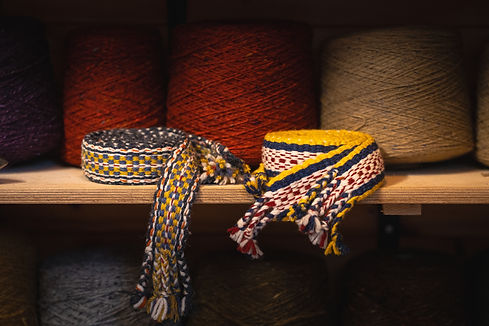
Crios Belt
The Crios is a traditional Irish handwoven belt, worn by men and women across all of Ireland. It survived through the penal laws when customs and culture were heavily restricted, including our religion, native language and traditional dress.
The crios gave support for the a farmer's back whilst tilling fields, lifting turf and when pulling in lobster pots and fishing nets along the Atlantic coast. It held up handwoven tweed trousers, and helped keep warmth in when the wind came down from the hills or off the sea. Simple and practical in form, but strong enough to survive the harshest of environments.
Today, the Crios lives on in Irish culture, as a fashion piece and most notably in handfasting ceremonies, ancient Celtic rituals where a woven sash binds two hands, and two lives, together. It’s a symbol of unity, love, tradition.
Each Crios I weave is a connection to the craft, to the land, to our heritage and to the people of Ireland. No two are alike, each one a reflection of the landscape that inspires it and culture that shapes it.